Static vs Dynamic Facial Reanimation describes two different ways of addressing the effects of facial paralysis. Weak facial muscles can affect a smile, lip control, speech and eye closure. Some operations support tissues that have dropped; others aim to restore an active source of movement. Understanding that distinction helps patients ask useful questions and judge whether a proposed treatment matches the problem they most want to improve.
Neither approach is automatically best for everyone. The cause of paralysis, remaining muscle function, nerve condition, previous treatment and personal priorities all matter. The parent guide, when static facial paralysis treatment is considered, explains the role of tissue support. This article compares that role with procedures intended to produce movement.
What does a static procedure do?
A static reconstruction changes the position or support of facial tissues without providing a new contracting muscle. A sling may support a drooping mouth corner or cheek. Fascia lata, a strong sheet of tissue from the thigh, is one possible material. It is not a functioning muscle transfer. Local tissues or other suitable materials may also be considered, depending on the defect and treatment plan.
The goals can include improved resting balance, better lip support and relief of selected problems caused by tissue descent. These benefits should be distinguished from recovering a moving smile. A face may look more balanced at rest while remaining uneven during expression. The static facial suspension guide explains the support mechanism in more detail.

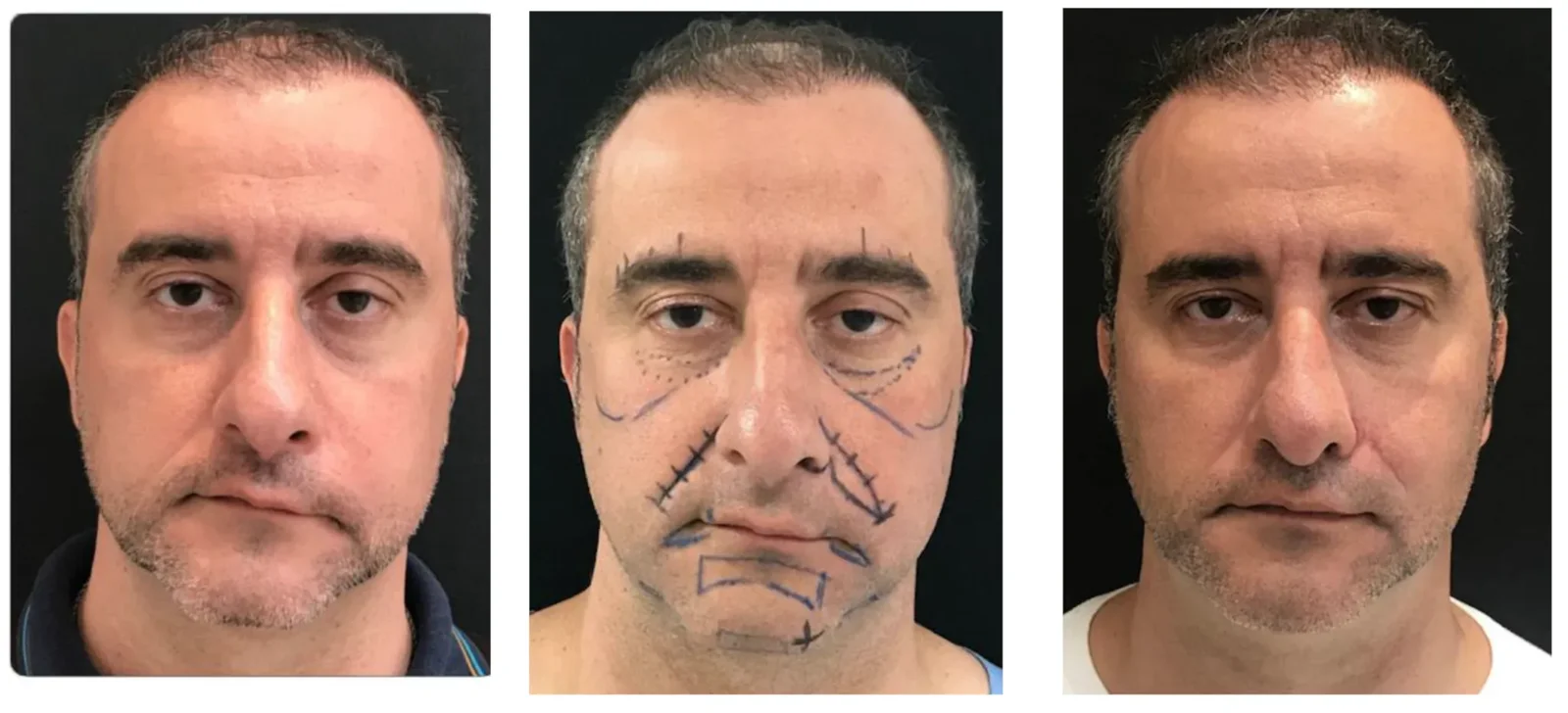
Research example of static nasolabial-fold reconstruction with a local dermal-fat flap; the source identifies the right panel as 12 months after surgery. Feitosa et al., Figure 2, 2024 preprint, CC BY 4.0; converted to WebP. Not peer-reviewed, not Dr. Rahmati’s patient and not a predicted individual result.
How does dynamic reconstruction work?
Dynamic treatment seeks to restore or introduce active force. When existing facial muscles remain suitable, selected nerve repairs, grafts or transfers may provide a pathway for new nerve input. A nerve graft cannot replace a muscle that is no longer usable. Assessment of the target muscle therefore matters as much as identifying an available nerve.
Free gracilis muscle transfer
A portion of gracilis muscle can be moved from the thigh with its blood vessels and nerve. Microsurgical connections establish circulation, while an appropriate motor nerve supplies the muscle. The nerve choice and whether treatment requires one or several stages influence rehabilitation and the expected pattern of movement. The gracilis smile reanimation guide explains why the operation is considered for selected patients with longstanding paralysis.
Temporalis tendon transfer and nerve procedures
Temporalis tendon transfer redirects force from a functioning chewing muscle toward the mouth corner. It differs from free muscle transfer and requires learning how to control the redirected action. Nerve-based reconstruction instead aims to activate suitable native muscles; see the guide to facial nerve reconstruction methods and the gracilis muscle transfer overview. Voluntary movement, a spontaneous emotional smile and symmetry at rest are separate outcomes; improvement in one does not guarantee complete recovery of the others.
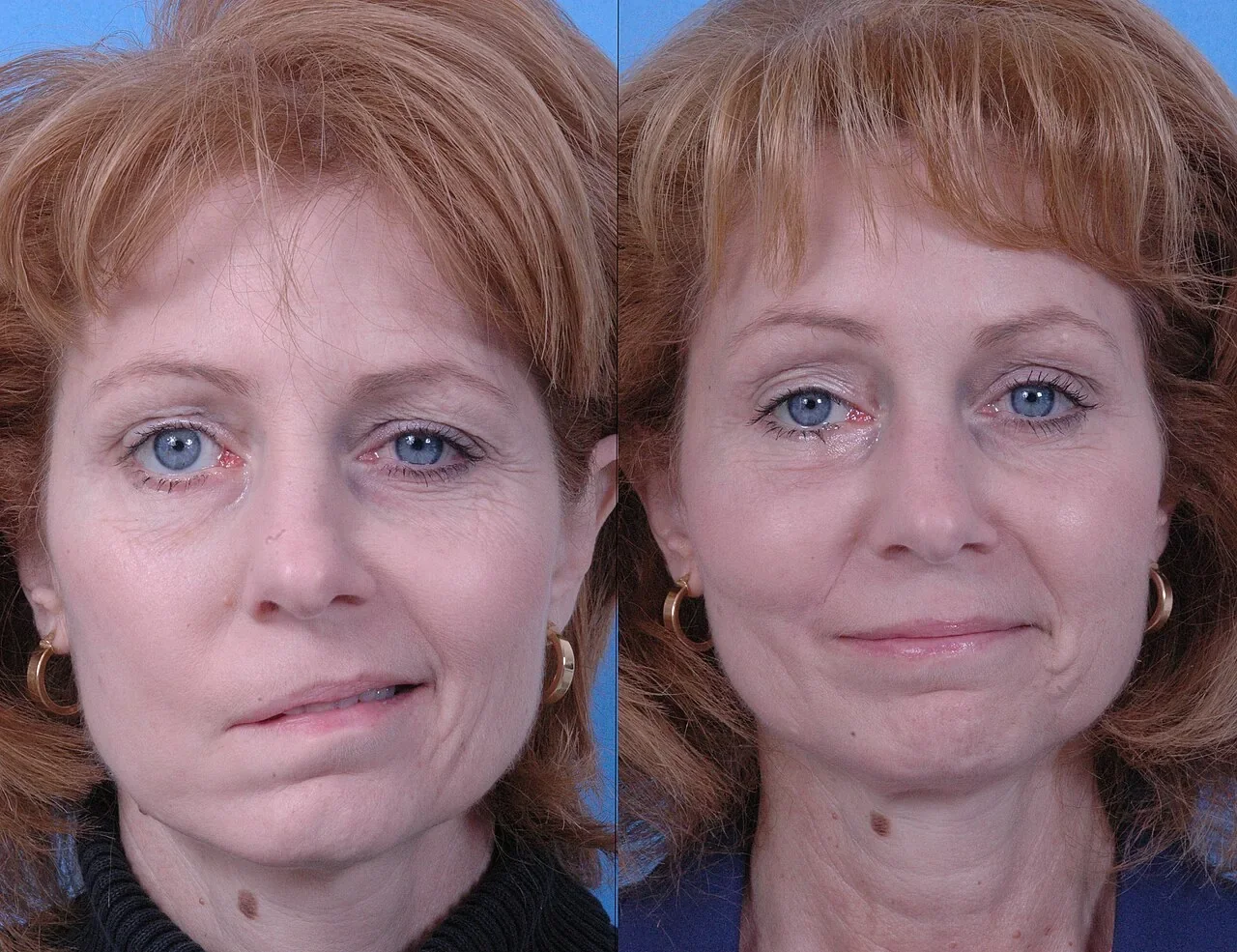
Before and after temporalis tendon transfer, not gracilis transfer. Sue Campbell / U.S. Air Force, Wikimedia Commons; identified as a U.S. government work in the public domain in the United States, converted to WebP. Educational source image, not Dr. Rahmati’s treatment or a guarantee of outcome.
Static vs Dynamic Facial Reanimation: comparison
| Feature | Static | Dynamic |
|---|---|---|
| Treatment goal | Support and reposition tissues | Restore or introduce active force |
| Active movement | Usually not newly created | A central goal, with variable results |
| Resting symmetry | An important target | May still require supportive treatment |
| Smile | Changes tissue position | Targets mouth-corner movement |
| Surgical complexity | Depends on technique and material | Ranges from tendon surgery to microsurgery |
| Rehabilitation | Healing and functional adaptation | Movement control and coordination training |
| Visible results | Assessed as swelling settles | Depend on technique, nerve recovery and practice |
| Patient selection | Selected needs for tissue support | Suitable conditions for movement reconstruction |
| Limitations | Support may loosen; no new active force | Variable movement; retraining or revision may be needed |
Which approach suits an individual patient?
Duration of paralysis matters, but the calendar alone cannot determine treatment. Examination considers residual movement, muscle condition, the cause of weakness and the possibility of nerve recovery. Electrical muscle testing or imaging may help when clinically indicated. Longstanding paralysis does not automatically exclude every dynamic option: a functioning muscle transfer may remain possible even when original muscles are unsuitable.
Age is also only one part of assessment. General health, previous radiation, tolerance of anesthesia and the ability to attend follow-up can change the balance of benefits and burdens. A patient primarily troubled by drooling may have different priorities from someone seeking stronger smile movement. These goals should be documented before choosing an operation.
Can static and dynamic treatments be combined?
Yes. One procedure may target active smile movement while another supports resting position. They can be planned together or in stages, depending on anatomy and recovery. More treatment is not automatically better; each component should address an identified problem. A remaining asymmetry after reconstruction also requires assessment rather than an assumption that the entire operation failed.

Eye protection deserves its own plan. Mouth-corner suspension does not treat every cause of incomplete eyelid closure. Similarly, a tight face with unwanted linked movements differs from a completely flaccid face. Increasing tissue tension without assessing the pattern of dysfunction may be inappropriate.
Care, risks and rehabilitation
Assessment usually includes photographs or video in standardized positions, examination during rest and expression, and review of medication and previous operations. Discuss bleeding, infection, scarring, donor-site symptoms and the possibility of revision. Free muscle transfer also carries risks related to blood supply. The relevant risks depend on the actual procedure, not simply its static or dynamic label.
After surgery, follow the treating team’s instructions for wound care, activity and the start of exercises. Specialist facial rehabilitation can teach controlled activation and coordination. Unsupervised forceful exercise is not a substitute. Progress is assessed over time as swelling changes and function develops, without a guaranteed recovery deadline.
Make the intended outcome specific
Ask the surgeon to describe the purpose of each proposed component separately: supporting the lip while drinking, changing cheek position or increasing mouth-corner movement. These questions are more useful than asking which operation is universally superior. Standardized photographs and video should compare similar expressions and camera positions; a different smile effort can make an apparent improvement difficult to interpret.
Discuss the number of stages, donor-site care, activity restrictions and when reassessment will be useful. Practical issues such as attending rehabilitation and arranging help during recovery belong in the decision. A good treatment goal describes daily function rather than promising identical appearance in every expression. New progressive weakness, an unexplained mass or an uncertain diagnosis should be investigated before cosmetic correction is planned.
Frequently asked questions
Will a static sling create an active smile?
Usually not. It supports tissue position; any remaining natural movement needs separate assessment and should not be confused with new muscle power.
Is dynamic treatment always the better choice?
No. A support-focused procedure may better match a particular functional goal, medical condition or informed patient preference.

Could another operation be necessary?
Yes. Tension, position or residual asymmetry may need adjustment. The likelihood depends on the procedure and individual healing.
Can photographs identify the best operation?
No. Still photographs cannot show all movement patterns, nerve function or daily difficulties. Clinical assessment remains essential.
What should I bring to a consultation?
Bring the onset history, previous operative reports, medication list and a short description of the activities you most want to improve.
Conclusion
Static support and dynamic movement reconstruction solve different problems. An individualized assessment, realistic goals and appropriate rehabilitation help determine whether one approach or a combination is suitable.


