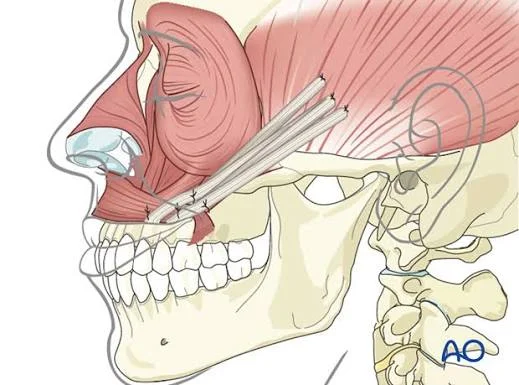
What is static facial suspension?
Static facial suspension is a reconstructive operation that supports drooping facial tissues in selected people with facial paralysis. A surgeon uses a strip of suitable tissue or another supporting material to reposition structures such as the corner of the mouth and cheek. Its main purpose is better balance when the face is resting. It may also help some problems with lip support. The operation does not repair the injured facial nerve or create a newly contracting smile muscle.
Understanding the word “static” is essential. Supporting the mouth corner is different from restoring active movement. A person may look more balanced at rest while still showing unequal movement when smiling. Planning therefore starts with the cause of paralysis, the condition of the muscles, and the specific problems the patient wants to address.
Why facial paralysis causes drooping
Facial muscles help position the lips and cheeks as well as produce expression. When nerve signals are lost, muscle tone and movement may decrease. In flaccid paralysis, the mouth corner can descend, the cheek may sag, and the fold beside the nose can become less defined. Some people experience saliva leakage, difficulty keeping drinks inside the mouth, or food collecting in the affected cheek.
These difficulties vary between individuals. A new episode of weakness needs diagnosis before anyone assumes a reconstructive operation is appropriate. Sudden facial weakness accompanied by speech difficulty or limb weakness warrants emergency assessment. Longstanding paralysis and recent weakness are not interchangeable clinical situations.

Who may benefit from a supporting sling?
A sling may be considered for persistent resting asymmetry, tissue descent, or inadequate support around the lips. Some people cannot safely undergo a longer reconstructive operation, while others mainly want better resting balance and oral support. Static support can also form one part of a broader treatment plan rather than being the only procedure offered.
Assessment includes remaining movement, unwanted associated contractions, previous operations, radiation treatment, skin condition, and general health. Someone with a tight or overactive face may need a different approach from someone with flaccid drooping. The site’s overview of facial nerve reconstruction methods explains why treatment options must be matched to the underlying problem.
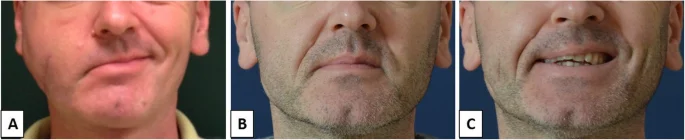
Published photographs before and six months after combined temporalis tendon transfer and fascia lata allograft in a study participant; not static suspension alone and not a patient of Dr Rahmati. Silan et al., 2020 — Fig. 2; CC BY 4.0. Converted to WebP.
What is fascia lata?
Fascia lata is a strong layer of connective tissue in the thigh. A carefully selected strip can be used as a supporting sling in the face. Because this is the patient’s own tissue, it is one established reconstructive option. Harvesting it nevertheless creates a second surgical site, with possible pain, bruising, scarring, or other local effects that require discussion before surgery.
Prepared tissue grafts and other materials may be considered in particular circumstances. Their advantages and limitations differ. The term “sling” describes a supporting arrangement, not one universal product or a guarantee of durability. Ask which material is planned and why it suits your health and reconstructive goals.
Assessment before surgery
The surgeon examines the face at rest, during smiling, and while speaking. Lip closure, saliva control, nasal breathing, and eye protection may also need assessment. Standardized photographs and short videos provide a baseline for later comparison. Relevant information includes medicines, smoking, existing medical conditions, and the details of previous facial treatment.
Describe the activity that troubles you most rather than asking only for a more symmetrical photograph. Appearance at rest, drinking, articulation, and spontaneous smiling are different goals. Do not stop prescribed medication, including medication affecting bleeding, without an agreed plan from the responsible clinicians.
How static facial suspension is performed
The surgeon plans the direction of support and places the selected strip along the intended pathway. It is secured to suitable anchoring tissues to support the affected structures. The amount and direction of tension are important: pulling more tightly does not automatically produce a better outcome. Incision placement and the extent of surgery depend on the area treated and any previous operations.

If fascia lata is used, harvesting tissue from the thigh is another part of the procedure. Anesthesia, admission arrangements, and the expected recovery plan should be explained for the individual operation. A timetable from another patient’s experience may not apply to your surgery.
How does it differ from gracilis transfer?
A static sling provides mechanical support. A free gracilis muscle transfer aims to provide a new source of contraction and movement. In the latter operation, muscle is transferred with blood vessels and a motor nerve; useful movement depends on circulation, reinnervation, and rehabilitation. These procedures therefore address overlapping but distinct goals.
Some treatment plans combine resting support with dynamic reconstruction. The parent article on smile reanimation with gracilis muscle transfer describes the dynamic approach. Choosing between them requires examining the patient, not simply ranking operations by complexity or comparing selected outcome photographs.
Recovery and practical care
Swelling, bruising, and a feeling of tightness may occur early in recovery. A thigh donor site also needs care when tissue has been harvested. Obtain specific instructions about wound cleaning, eating, activity, and follow-up appointments. Avoid forceful massage, pulling on healing tissues, or starting exercises without permission from the treating team.
The early postoperative appearance is not the final result. Swelling changes and tissues settle over time. Return to work and sport depends on the operation and the person’s recovery. Planning help with travel and daily responsibilities can make the early period easier, especially when there are wounds at both the face and thigh.
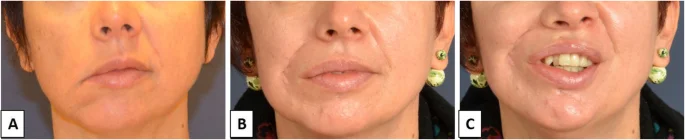
Published photographs before and six months after combined temporalis tendon transfer and fascia lata allograft in another study participant; not static suspension alone and not a patient of Dr Rahmati. Silan et al., 2020 — Fig. 3; CC BY 4.0. Converted to WebP.
Risks and possible revision
Potential risks include bleeding, infection, wound problems, altered sensation, scarring, and complications associated with anesthesia. Too much or too little tension, persistent asymmetry, visible contour changes, and a gradual loss of support can also occur. Materials other than the patient’s own tissue have material-specific risks that should be explained separately.
Further adjustment may be needed as tissues change or support becomes less satisfactory. No sling guarantees perfect lifelong symmetry. Increasing pain or swelling, fever, unexpected bleeding, or wound discharge should prompt contact with the surgical team. Discuss in advance whom to contact outside normal clinic hours.

Setting realistic expectations
A meaningful result should be judged against the original problem: resting lip position, cheek support, or a particular everyday difficulty. Clinical studies have reported improvements in resting balance and oral competence with supporting slings, but patient groups, materials, and outcome measurements differ. One person’s experience cannot predict another person’s benefit or complication risk.
If the main priority is an actively moving smile, nerve or muscle reconstruction may also need discussion. Eye closure and protection of the cornea are separate concerns. Supporting the lower face does not replace appropriate eye care, and an uncomfortable or exposed eye should not wait for completion of a smile reconstruction plan.
Questions to bring to your consultation
Ask which of your difficulties a static sling is expected to improve and which would require restoration of movement. Discuss the planned material, any donor site, likely remaining asymmetry, and circumstances that might lead to revision. Clarify how follow-up will work and when the result can reasonably be assessed. Bring your medication list and previous operative reports. Writing down practical problems with eating, drinking, and speech can help the consultation focus on your priorities instead of an idealized photograph.
Conclusion
Static facial suspension can provide useful support for selected people with facial paralysis and tissue drooping. The material chosen, direction of tension, and realistic treatment goals all matter. It does not restore nerve function or independently generate a normal active smile. A specialist assessment can determine whether static support, dynamic reconstruction, or a combined approach best addresses the person’s functional priorities.