Bell’s palsy is relatively rapid weakness or loss of movement on one side of the face when a clinical assessment does not identify another cause. A person may notice an uneven smile, difficulty closing an eye or liquids escaping through the lips. Early assessment matters because treatment decisions can be time-sensitive, and protecting the eye should not wait for facial movement to recover.
However, a new facial droop is not automatically Bell’s palsy. Sudden weakness with abnormal speech, arm or leg weakness, imbalance or visual changes requires immediate contact with the local emergency service. Symptoms that disappear briefly can still be serious. The parent article, diseases causing facial paralysis, explains other conditions that may need a different approach.
What is Bell’s palsy?
The facial nerve carries movement signals to many muscles of expression. Inflammation and swelling are thought to contribute to the disruption in Bell’s palsy. Reactivation of certain viruses has been studied, but a particular virus cannot be confidently identified as the cause in every patient. The diagnosis depends on an appropriate history and examination, rather than assuming that all one-sided weakness has the same explanation.
Weakness can be partial or severe. The distribution across the forehead, eye and mouth helps the clinician assess the pathway involved. It does not provide a reliable home test for excluding stroke. A still photograph alone cannot establish the diagnosis or show all the functional difficulties a patient experiences.

Symptoms and everyday problems
A drooping mouth corner, difficulty raising the eyebrow and incomplete eyelid closure are important signs. Some patients experience altered taste, dry mouth, discomfort around the ear or sound sensitivity. A watering eye may also occur when blinking is impaired. Excess tears do not necessarily mean that the exposed eye surface is adequately protected.
Drinking, chewing, pronunciation and confidence can all be affected. Facial appearance does not fully describe these problems. Tell the clinician about food collecting in the cheek, leaking liquids or eye discomfort. The guide to facial nerve palsy symptoms provides further context about movement and daily function.

Real self-photograph on day two of Bell’s palsy during forehead movement, Andrea Kamphuis. Not Dr. Rahmati’s patient or a surgical outcome. Andrea Kamphuis / Wikimedia Commons · CC BY-SA 4.0 · WebP.
Which findings need a different assessment?
Severe ear pain, blisters around the ear or mouth, hearing changes and dizziness may prompt consideration of Ramsay Hunt syndrome. Travel or tick exposure in a Lyme-endemic area is also relevant. Gradual progression, repeated weakness on the same side, a mass or findings involving other nerves should not automatically receive the previous diagnosis without review.
Bilateral weakness or accompanying limb weakness, swallowing difficulty or breathlessness requires prompt assessment. These clues are intended to guide care, not to diagnose a rare disease from one symptom. A medication that helped somebody else with a similar-looking face may be inappropriate when the underlying explanation is different.
How is the diagnosis made?
The clinician asks when weakness started, how it progressed, and whether there are ear, eye or other neurological symptoms. Examination includes facial movement at rest and during eyebrow elevation, eye closure and smiling. Other nerve and limb functions may also be checked. Being able to describe the last time the face moved normally can help with early treatment decisions.
Not every patient needs an MRI, broad laboratory testing or electrical nerve studies. Testing may be limited in a typical uncomplicated presentation. Atypical findings, progression or an unexpected recovery pattern can justify targeted investigations. Follow-up is part of diagnostic care; an initial label should be reconsidered if the subsequent course no longer fits.
Early treatment and medicines
Randomized trials support early corticosteroid treatment for suitable adults. Clinical guidance emphasizes prompt assessment, particularly within the first 72 hours. This is not advice to start medication without medical review, nor a reason to avoid seeking care after that period. The clinician must consider timing, the diagnosis and individual treatment risks.
Antiviral medication alone is not a substitute for established treatment. Adding an antiviral may be discussed in selected circumstances, but extra benefit is not certain or identical for every patient. Diabetes, pregnancy, kidney disease, possible infection and other medicines can influence prescribing. This article does not provide a personal prescription or dosing schedule.

Protecting an eye that does not close
Incomplete eyelid closure can leave the cornea vulnerable to dryness and injury. The team may recommend appropriate lubrication and teach a safe nighttime protection method. If eyelid taping is advised, technique matters: pressure on the eye or incorrectly applied material can cause problems. Simply covering the eye does not guarantee that the eyelid remains closed.
Eye pain, marked redness, light sensitivity or reduced vision needs prompt assessment. Do not postpone eye care until movement improves. If a moisture chamber or another device is prescribed, ask how to use and clean it. A photograph showing one patient’s protective device is an educational example, not a universal product recommendation.
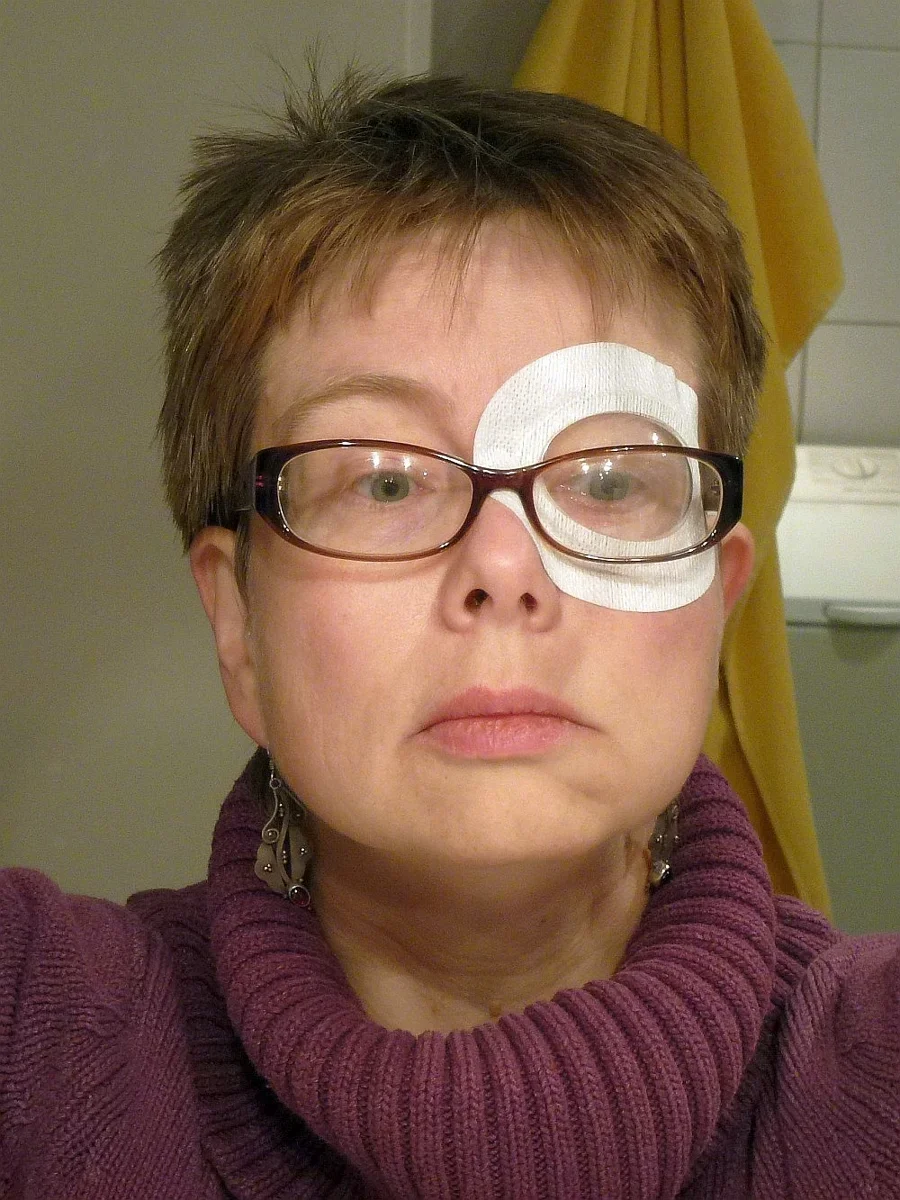
Real moisture-chamber eye dressing on day one of Bell’s palsy, self-photograph by Andrea Kamphuis. Educational example, not a universal device recommendation or treatment outcome. Andrea Kamphuis / Wikimedia Commons · CC BY-SA 4.0 · WebP.
Recovery and specialist rehabilitation
Many people improve, but recovery time and extent vary. Initial severity, nerve condition and associated medical factors influence assessment. A promise of complete recovery by a fixed date is unreliable. Different movements may return at different rates, and persistent weakness or unwanted linked movements may need separate evaluation.
Specialist rehabilitation can help selected patients learn controlled, coordinated movement. Forceful unsupervised exercises, painful massage or electrical stimulation without assessment should not be treated as proven shortcuts to nerve repair. The timing and content of therapy should fit the person’s condition. Standardized photographs and video can make progress comparisons more meaningful.
When should follow-up be brought forward?
Attend the planned review and contact the team sooner for worsening weakness or new symptoms. Persistent pain, recurrence or an unexpected lack of progress can prompt reassessment. Ask who will monitor recovery and when the eye will be checked. A clear plan makes observation an active process rather than waiting indefinitely without guidance.
If weakness remains, the nerve, muscle function and diagnosis should be reviewed before considering reconstruction. Surgery is not necessary for everyone. For selected persistent problems, tissue support or movement reconstruction may be discussed; static versus dynamic facial reanimation explains their different goals.
Bring your symptom timeline, medicine list and previous reports to the appointment. Explain concerns about appearance or social interaction as well as movement. Clear information and appropriate emotional support belong within patient-centered care.
Frequently asked questions
Is Bell’s palsy contagious?
The weakness itself is not contagious. If another infectious condition is diagnosed, contact precautions depend on that condition and should be discussed separately.

Does stress or cold air prove the cause?
No. Symptoms following stress or cold exposure do not establish causation and should not delay assessment of new weakness or warning signs.
Are antibiotics needed?
Antibiotics are not routine treatment without an identified bacterial infection. Conditions such as Lyme disease require a different diagnostic and treatment pathway.
Will I definitely need an operation?
No. Early care usually focuses on appropriate treatment, eye protection and follow-up. Reconstruction is considered for a defined need in selected circumstances.
Conclusion
Accurate assessment, timely care and eye protection are central to managing Bell’s palsy. Individual treatment, planned follow-up and realistic expectations are more useful than copying another patient’s medication or judging recovery from before-and-after photographs alone.


