A Facial Nerve Tumor is a growth arising from tissues associated with the facial nerve. Sometimes a nearby tumor instead compresses or extends along this nerve. These are different situations, with different treatment priorities. Many primary facial nerve tumors, including schwannomas, are benign. However, a benign growth can still interfere with facial movement or hearing, and its effect depends on more than its name.
Assessment aims to identify the lesion while protecting function and controlling disease. Facial weakness alone does not establish that a tumor is present. The parent guide to diseases causing facial paralysis explains other possible causes. This article supports a discussion with the clinical team; it cannot interpret an individual scan or determine which treatment a particular patient needs.
What is a Facial Nerve Tumor?
The seventh cranial nerve travels near the brainstem, through the temporal bone and then out of the skull. It branches within the region of the parotid gland to supply muscles of facial expression. A lesion near the ear may be investigated because of hearing changes, whereas an extracranial lesion may appear as a lump near the ear. Location is therefore central to understanding symptoms.
Ask whether the growth originates from the facial nerve, sits beside it or spreads along it from another site. These descriptions should not be treated as interchangeable.

Important types and diagnostic distinctions
Facial nerve schwannoma
A schwannoma develops from Schwann cells, which normally support and insulate nerve fibers. Facial nerve schwannomas are generally benign and often grow slowly. Some are discovered while facial movement remains good, including during investigation of hearing problems. The degree of weakness and the size of the lesion do not always correspond closely, so neither should be interpreted in isolation.
A vestibular schwannoma arises from the balance nerve and is a different condition, although these nerves lie close together. This proximity can make imaging interpretation difficult. The word “schwannoma” alone does not establish which nerve is involved. Review by clinicians familiar with skull-base anatomy helps clarify the likely origin and the implications for treatment.
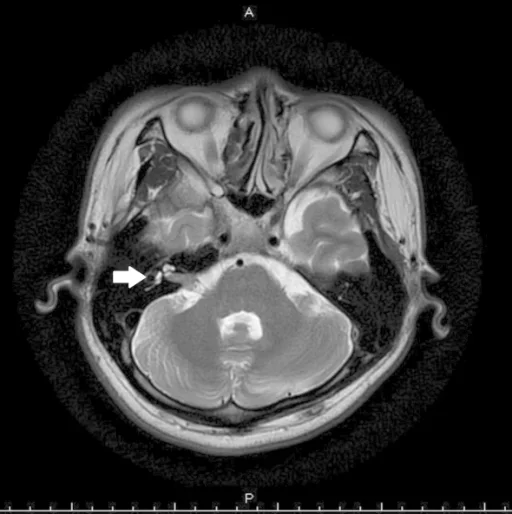
Real MRI from a published facial nerve schwannoma case; the arrow identifies the reported lesion. Not Dr. Rahmati’s patient or a treatment outcome. Chen MC and colleagues / Wikimedia Commons, CC BY-SA 3.0; converted to WebP.
Nearby tumors and vascular mimics
Some skin and parotid cancers can involve the facial nerve. Their management differs from that of a benign schwannoma. A lump near the ear accompanied by facial weakness or persistent pain deserves assessment, but these findings do not independently prove cancer. The origin, tissue diagnosis when appropriate, and extent of disease determine the next steps.
Some vascular lesions historically called facial nerve hemangiomas are now better classified as venous malformations. They illustrate why not every mass is a true tumor. Imaging, clinical findings and, when required, pathology must be considered together. A term in an old report may need clarification before it is used to explain prognosis or choose an operation.
Symptoms that should be discussed
Possible presentations include gradually increasing one-sided facial weakness, recurrent weakness on the same side, facial twitching, hearing loss or tinnitus. A palpable lump, persistent pain or altered sensation may provide other clues. Absence of pain does not exclude a lesion, but facial weakness is far more than a tumor diagnosis and should not automatically be interpreted as cancer.
Describe the sequence of changes: which movement changed first, whether the eye closes fully, and when hearing became different. If the original diagnosis was Bell’s palsy, continuing progression or an unexpected recovery pattern warrants review. Repeating the same medication without reconsidering the diagnosis may miss the reason that recovery is not following the expected course.
Sudden facial weakness with abnormal speech, arm or leg weakness, visual changes or loss of balance requires immediate contact with the local emergency service. Do not assume that an existing tumor explains a new neurological event. An eye that does not close also needs protection; eye pain or deteriorating vision requires urgent assessment rather than waiting for a routine appointment.
How are these lesions investigated?
Assessment includes facial movement, eyelid closure, the ear, hearing and other relevant neurological functions. Previous surgery, skin cancer and parotid disease are important parts of the history. Standardized facial grading helps compare examinations, but daily problems such as drinking, speech and eye discomfort should also be documented.

MRI tailored to the clinical question, often with contrast, examines the nerve pathway and surrounding soft tissues. High-resolution CT may provide additional information about the temporal bone. Hearing tests and selected nerve-function studies can support planning. Not every patient needs every test.
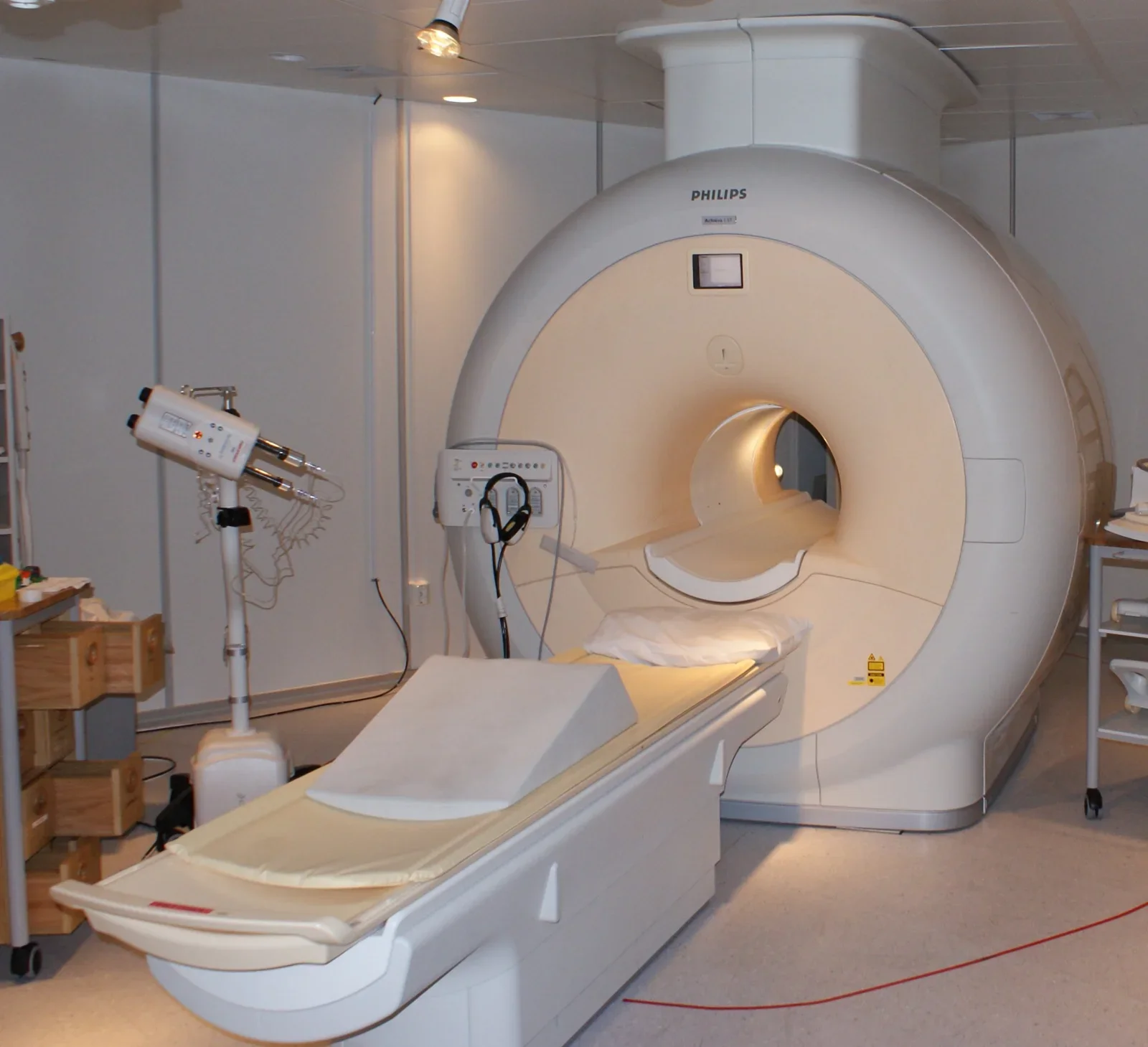
Real photograph of an MRI scanner, illustrating diagnostic equipment rather than a tumor or Dr. Rahmati’s clinic. Jan Ainali / Wikimedia Commons, CC BY 3.0; converted to WebP.
An initially reassuring scan does not always end investigation when weakness continues to progress. Specialist review of the original images or targeted follow-up imaging may be appropriate. This does not mean that every patient needs repeated scans without a reason. The changing symptoms, coverage of the original examination and a specific diagnostic question should guide the plan.
Biopsy is not a uniform step for every lesion. Sampling a mass within a nerve can affect its function, while a parotid mass may require a different approach. Ask what information a biopsy would provide, whether it would alter treatment and what functional risks are involved. The specialist team should select the site and method rather than treating all lumps identically.
Observation, radiation or surgery?
Active surveillance can be appropriate for selected stable schwannomas with useful facial function. It means planned clinical examinations and imaging, not abandoning care. Clarify the next review date, which symptoms should prompt earlier contact and what changes would trigger treatment. Observational studies help inform this discussion but cannot guarantee that one individual’s tumor or facial movement will remain unchanged.
Stereotactic radiosurgery may be considered for selected schwannomas to control growth. It does not necessarily restore movement already lost, and follow-up remains necessary. Discuss possible effects on hearing and nerve function as well as the limitations of the evidence. It is not a universal replacement for surgery or for the cancer-specific treatment of a different malignant lesion.
Surgery may be considered when growth, compression, declining function or diagnostic and disease-control needs justify intervention. The extent of removal and the possibility of preserving the nerve depend on the lesion. Complete removal is not always the best functional choice. If removal of an affected nerve segment may be necessary, discuss reconstruction before the operation rather than only afterward.
Eye care and facial reconstruction
Controlling a tumor and restoring facial movement are related but separate goals. Depending on muscle condition and the primary treatment plan, persistent weakness may lead to discussion of nerve repair, nerve transfer, muscle transfer or supportive procedures. No technique guarantees the original face will return. Goals for eyelid closure, smile and oral control should be discussed individually.
When the eyelid does not close, obtain advice about lubrication and safe nighttime protection. Forceful exercises or massage do not treat the growth. Bring previous scans and reports to discuss functional goals and the follow-up plan.

Frequently asked questions
Does a Facial Nerve Tumor always mean cancer?
No. A schwannoma is generally benign. The specific lesion still needs identification, and a benign diagnosis does not remove the need to monitor function.
Does every patient need immediate surgery?
No. Decisions depend on lesion type, growth, location, facial movement and hearing. Active surveillance can be appropriate in selected circumstances.
Will facial movement definitely recover after treatment?
No. Disease control and functional recovery are different outcomes. Nerve and muscle condition influence whether additional reconstructive treatment may help.
Conclusion
Care for a Facial Nerve Tumor should address both an accurate diagnosis and everyday function. Planned follow-up, attention to changing symptoms and a clear discussion of benefits and risks support an individualized decision rather than a single treatment rule for everyone.
Medical references
- Mayo Clinic, 2016: 80 cases
- Loos et al., 2020: multicenter study
- Sah et al., 2018: imaging
- Cho et al., 2024: observation
- Marinelli et al., 2026: radiosurgery
- Chung et al., 2022: occult tumors
- Guerin et al., 2019: venous malformations
- Terzis et al., 2012: reconstruction
- NCI: salivary gland cancer
- NHS: eye protection
- CDC: stroke warning signs


